HILAME. A prosopography of people who lived in the Middle Ages.
Links and Networks
«Links and Networks» stems from a desire to explore and understand data
representations—visual, kinetic, and interactive. It is inspired by the possibility of
discovering unexpected results through new ways of seeing.
What we see here is a pilot—a prototype of what we plan to keep developing
seamlessly. Our goal is to achieve interoperability among various applications (both our
own and others) and to apply technologies for multidimensional data visualization.
In the current version:
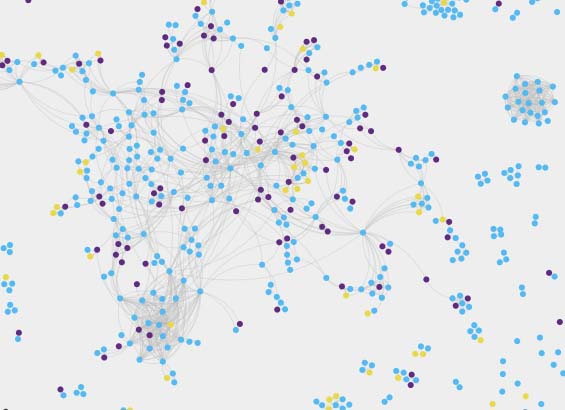
The circles represent people (identified or anonymous), whose names appear
when hovering over a node or zooming in.
The node colors indicate categories that distinguish gender (female, male,
undetermined, both, and other) and allow filtering by gender.
The gray lines represent factoids, illustrating peer-to-peer links and subnetworks within the set.
A search by first and/or last name returns the selected person at the center (EGO) and displays information about their connections in the information panel on the right.
The Redada Murcia project workshop held in 2011, led by Jaron Rowan, for its inspiring approach to collaboratively building interactive sociograms. (Its use of Flash technology means it is no longer accessible.)
Later discoveries included the free analyzers Tweet Topic Explorer and Orbit, which we used to complement the analytics of our Twitter channel. Unfortunately, neither remains active. Moreover, in early 2025 we decided to hibernate our account on the social network now called X, awaiting better conditions for science communication on that platform.
We would also like to acknowledge Víctor Pascual, teacher and co-founder of One Tandem. Together with him and his partner Pere Rovira, we created this first version of Links and Networks (Vínculos y Redes), a Gephi output derived from a GDF export and programmed using an initial selection from our prosopographical database.
We must also thank Professors Arsenio Dacosta and Cristina Calvo from the University of Salamanca (USAL), who coordinated the Humanities + DataViz group for the HeC 2024 Meeting held at the University of the Basque Country (UPV/EHU) in Vitoria- Gasteiz in June 2024. This represents another step forward in our exploration of data visualization, a path we are eager to pursue further.